
Children’s Clothing Size Chart
Children grow quickly, and clothing sizes can vary significantly between brands and countries. Our kids’ clothing size chart helps you convert between UK, US, EU, and international sizing systems using age and height as a guide. Because children of the same age can differ greatly in build, we recommend always measuring your child rather than relying solely on age labels.
Quick Tip for Parents
Children can grow 5–8 cm per year between ages 2 and 10. If you’re between sizes, choose the larger size — your child will grow into it, and slightly roomier clothing is more comfortable for active play.
Quick Size Reference by Age
These age ranges are approximate guidelines. Heights and builds vary, so always check specific measurements for the best fit.
Toddlers (1–3 years)
UK: 1–3 | US: 2T–3T | EU: 80–98
Height: 80–98 cm. Growing rapidly; re-measure every 2–3 months.Pre-School (3–5 years)
UK: 3–5 | US: 3T–5 | EU: 98–110
Height: 98–110 cm. Active age; prioritise durable, stretchy fabrics.School Age (5–8 years)
UK: 5–8 | US: 5–8 | EU: 110–128
Height: 110–128 cm. School uniform sizes may differ from casual wear.Tweens (8–12 years)
UK: 8–12 | US: 8–14 | EU: 128–152
Height: 128–152 cm. Growth spurts common; check sizes before each season.Children’s Clothing Sizes by Age & Height
This chart maps age ranges to standard sizes across UK, US, and EU systems. The height column is the primary guide used by most European brands.
| Age | UK | US | EU | Height (cm) | Chest (cm) | Waist (cm) |
|---|---|---|---|---|---|---|
| 1–1.5 years | 1–1.5 | 18M | 80–86 | 80–86 | 49–51 | 48–50 |
| 1.5–2 years | 1.5–2 | 2T | 86–92 | 86–92 | 51–52 | 50–51 |
| 2–3 years | 2–3 | 2T–3T | 92–98 | 92–98 | 52–54 | 51–52 |
| 3–4 years | 3–4 | 3T–4T | 98–104 | 98–104 | 54–56 | 52–53 |
| 4–5 years | 4–5 | 4–5 | 104–110 | 104–110 | 56–58 | 53–54 |
| 5–6 years | 5–6 | 5–6 | 110–116 | 110–116 | 58–60 | 54–55 |
| 6–7 years | 6–7 | 6–7 | 116–122 | 116–122 | 60–62 | 55–57 |
| 7–8 years | 7–8 | 7–8 | 122–128 | 122–128 | 62–65 | 57–59 |
| 8–9 years | 8–9 | 8–9 | 128–134 | 128–134 | 65–68 | 59–61 |
| 9–10 years | 9–10 | 9–10 | 134–140 | 134–140 | 68–71 | 61–63 |
| 10–11 years | 10–11 | 10–12 | 140–146 | 140–146 | 71–74 | 63–65 |
| 11–12 years | 11–12 | 12–14 | 146–152 | 146–152 | 74–78 | 65–67 |
Note: Ages are approximate. A slim 7-year-old and a broad 7-year-old may wear different sizes. Use height and chest measurements as the primary guide.
How to Measure Your Child
Getting accurate measurements takes just a few minutes and saves you from the hassle of returns. Here’s how:
Height
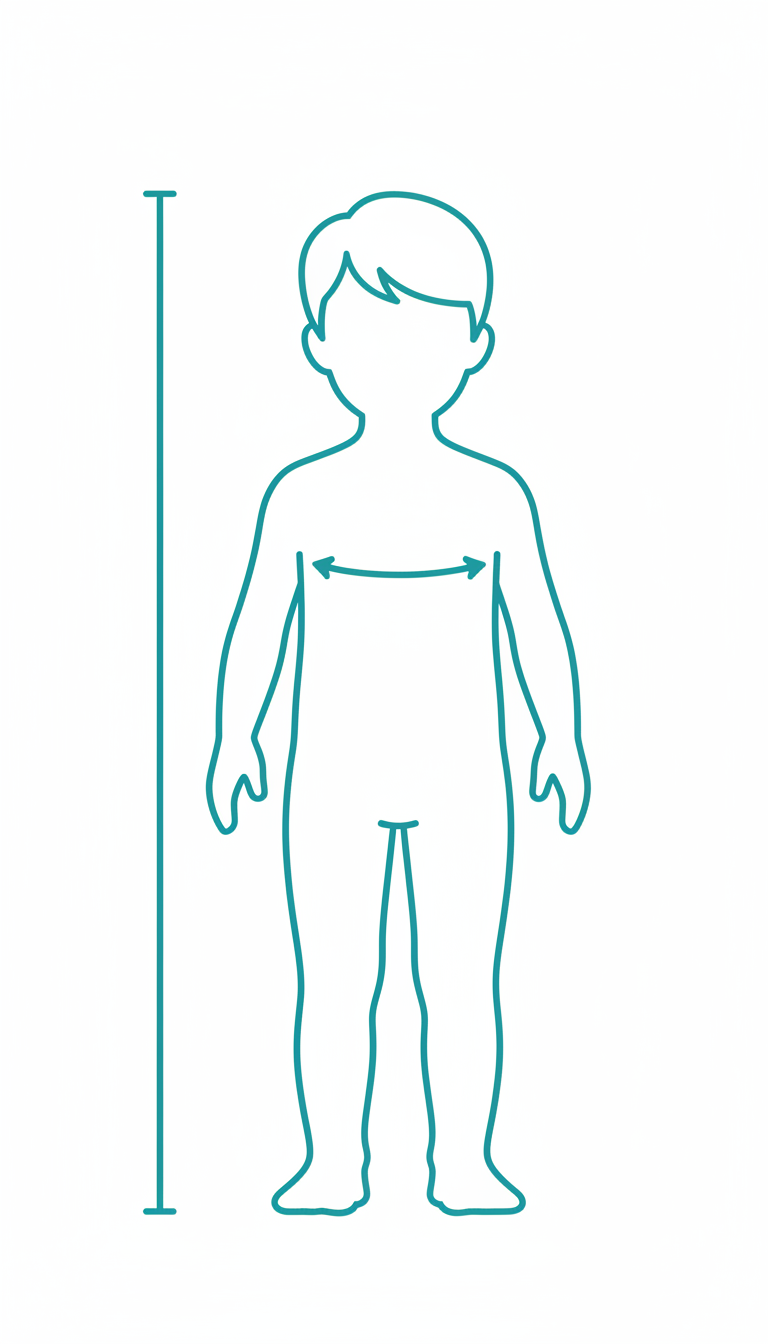
Have your child stand against a wall without shoes. Place a flat object (like a book) on top of their head level with the wall, and mark the point. Measure from the floor to the mark. This is the most important measurement for children’s clothing in European sizing.
Chest
Wrap the tape around the widest part of the chest, under the arms. Keep it snug but not tight — you should be able to slide one finger between the tape and your child’s body.
Waist
Measure around the natural waistline. For younger children, this is the narrowest point of the torso. Don’t pull the tape tight — children need room to move, eat, and be comfortable.
Inside Leg
For trousers, measure from the crotch to the ankle. Alternatively, measure a pair of well-fitting trousers from the crotch seam to the hem.
Essential Tips for Parents
Shopping Tips
- If between sizes, always size up — children grow into clothes quickly
- Check care labels: some fabrics shrink after washing
- Look for adjustable waistbands in trousers for a better fit as your child grows
- Consider the season — winter clothing often needs extra room for layering
- For school uniforms, buy one size up at the start of the school year
Fit Guide
- Tops: Should allow free arm movement without riding up
- Trousers: Adjustable waist is ideal; trouser legs should reach the ankle
- Coats: Size up to allow room for jumpers underneath
- Sleepwear: Should be snug-fitting for safety (unless flame-resistant)
- Swimwear: Should fit snugly; sizing down may be needed for a secure fit
Brand Differences
- Next: Tends to run slightly large — good for growing room
- M&S: True to size with generous length
- H&M: European cut; may run slim on British children
- Primark: Generally true to age labels
- John Lewis: Generous sizing; quality fabrics hold shape well
When to Size Up
- Sleeves or trouser legs are getting noticeably short
- Buttons or poppers are straining across the chest
- Your child complains that clothes feel tight or uncomfortable
- Growth spurts are common at ages 2–4, 6–8, and 10–14
- If buying for the next season, go up one full size
Understanding Children’s Sizing Systems
UK Sizing
UK children’s clothing typically uses age ranges (e.g., 3–4 years). Some brands also include height in centimetres on the label, which is more reliable than age alone.
US Sizing
US sizes use age-based numbers with a “T” suffix for toddlers (2T, 3T, 4T). After size 5, the T is dropped. US sizes tend to run slightly larger than UK equivalents.
EU Sizing
European sizing is height-based (e.g., 104 means the garment fits a child approximately 104 cm tall). This is the most practical system as it’s based on a measurable dimension rather than age.
Baby Sizing (0–24 months)
Baby clothes are usually sized by age in months (0–3M, 3–6M, 6–9M, etc.). Growth is fastest in the first year, so babies may move through sizes every 2–3 months.